



Most electric scooters travel 15 to 40 miles on one charge, but the honest real-world number is closer to 60 to 75 percent of that. A scooter advertised at 30 miles will realistically give a 180 lb rider about 18 to 23 miles in mixed city use. The biggest single factor is battery capacity in watt-hours (Wh): roughly 1 mile of real range for every 22 to 30 Wh, depending on speed, weight, and terrain. Below we break down what actually decides range, the claimed-vs-real gap on tested scooters, and how to estimate your own number in 10 seconds.
In this guide
- The short answer (and who it's for)
- What actually decides range
- Why real range is lower than claimed range
- How to estimate your own range
- Range by scooter type and DRIDER model
- How to get more range from the same battery
- FAQ
The short answer (and who it's for)
If you are a daily commuter riding 3 to 8 miles each way, almost any modern commuter scooter with a 400 Wh or larger battery will cover your round trip with charge to spare. The how far question only gets tense at the edges: long-haul riders past 20 miles, heavier riders, and anyone who rides flat-out the whole way.
Here is the rule we keep coming back to after testing commuter scooters on real routes: take the advertised range and plan around 65 percent of it. Manufacturers quote range under ideal lab conditions, a light rider, flat ground, steady low speed, and eco mode. Your commute is none of those things. Planning around 65 percent means you never get stranded, and you are pleasantly surprised on a good day instead of stressed on a bad one.

Real range depends on how you ride, not just the spec sheet. The Zero 9's 624 Wh battery is rated 25 miles; plan for high teens to low 20s in real city use.
What actually decides range
Range is not one number, it is the result of six things stacking up. In rough order of impact:
- Battery capacity (Wh). The single best predictor. Watt-hours = volts x amp-hours. A 48V 13Ah pack is 624 Wh. More Wh means more stored energy and more miles. This is the number to compare, not Ah alone, because a 36V and a 48V pack with the same Ah hold different energy.
- Speed. The quiet range killer. Air resistance rises sharply with speed, so the last few mph cost the most energy. Cruising at 25 mph can use 40 to 60 percent more energy per mile than cruising at 15 mph. This is why range and top speed pull against each other.
- Rider weight. Every extra 40 to 50 lb of rider and cargo measurably shortens range, especially on hills and from a standstill. A 130 lb rider and a 230 lb rider on the same scooter can see a 20 to 30 percent range difference.
- Terrain. Hills force the motor to draw heavy current. A route with real climbing can cut range by a third versus flat ground.
- Temperature. Lithium batteries lose usable capacity in the cold. Below 40F you can lose 10 to 20 percent of range until the pack warms up.
- Riding style and stops. Hard acceleration from every light burns far more than smooth, steady cruising. Stop-and-go city riding costs more than an open bike path.
None of these show up on the box. That gap between the printed number and your real number is exactly what the next section measures.
Why real range is lower than claimed range
This is the honest part most scooter pages skip. Advertised range is a best-case lab figure: light test rider, flat track, eco mode, steady low speed, fresh battery, warm day. Change any one of those and the number drops. Here is the realistic real-world range we plan around for three common battery sizes, against the typical advertised claim.
Claimed range vs realistic mixed-city range
Realistic = ~65% of claim. Conditions: ~180 lb rider, mixed urban with light hills, normal mode, ~60F. Illustrative planning figures, not a single lab test.
500 Wh pack · claimed 30 mi
Realistic ~19 to 21 mi
624 Wh pack · claimed 25 mi
Realistic ~17 to 21 mi
720 Wh pack · claimed 35 mi
Realistic ~22 to 26 mi
Bars scaled to the largest claim. The point is the gap between the top bar and the green bar in each pair.
Notice the 624 Wh pack has a lower claimed number than the 500 Wh pack in this example. That is not a mistake, it is the speed-vs-range trade-off in action: a faster, more powerful scooter spends more energy per mile, so a bigger battery can still carry a lower range rating. Always compare watt-hours, not the advertised range number alone.
How to estimate your own range in 10 seconds
You do not need a lab. Use this:
Real range (miles) = Battery Wh ÷ energy use per mile
Use 22 Wh/mi for steady eco riding, 28 Wh/mi for normal mixed riding, and 36 Wh/mi for aggressive top-speed riding.
Example: a 624 Wh battery in normal mixed riding = 624 ÷ 28 = about 22 miles. The same battery ridden flat-out = 624 ÷ 36 = about 17 miles. That 5-mile swing is entirely down to how you ride.
Rather not do the math? Our electric scooter time and range calculator has a Battery & Range tab that does this instantly: enter your battery Wh, riding style, and trip distance, and it returns your maximum range, ride time, percentage of battery used, and how many round trips you get. It is the fastest way to sanity-check a scooter against your actual commute before you buy.
Range by scooter type, and which DRIDER model fits
Range only means something next to a use case. Here is what each tier of scooter realistically does, and where our two commuters land.
| Scooter type | Battery | Claimed range | Realistic range | Best for |
|---|---|---|---|---|
| Shared rental (Lime, Bird) | ~280 Wh | ~15 mi | 8 to 12 mi | One-off short hops |
| Entry-level adult | ~270 Wh | 15 to 18 mi | 9 to 13 mi | Light, occasional use |
| Compact commuter (Zero 8) | 500 Wh | 30 mi | ~19 to 21 mi | Trips under 8 mi, value |
| All-round commuter (Zero 9) | 624 Wh | 25 mi | ~17 to 21 mi | Daily 5 to 10 mi commutes |
| Long-range (Wide Wheel Pro) | 720 Wh | 35 mi | ~22 to 26 mi | Longer or hilly routes |
Two honesty notes on our own scooters. First, these are compact-folding commuters, not lightweights: both Zeros weigh about 40 lb, so plan for occasional carry, not daily stair-hauling. Second, the Zero 9 is rated 25 miles and tops out around 29 mph GPS-verified, not a flat 30. We market it as a 30 mph electric scooter because that is what riders search, but the verified number is what we stand behind on the road.
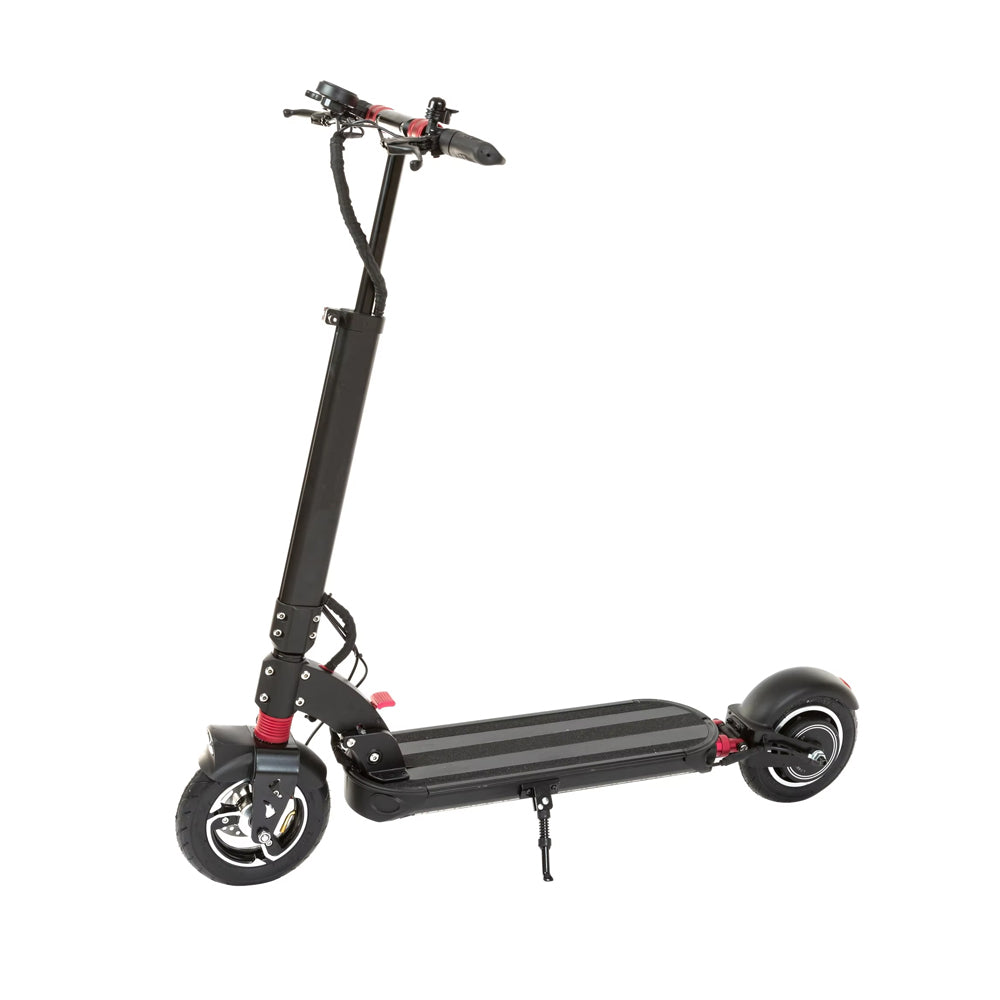
Best for daily 5 to 10 mile commutes
Zero 9
624 Wh battery, front and rear pneumatic tires, front disc brake. Realistic high-teens to low-20s range and ~29 mph GPS-verified top speed.
$799 Shop the Zero 9 →

Best for trips under 8 miles on a budget
Zero 8
500 Wh battery, very narrow folded width for apartment storage. The compact, value pick when your route is on the shorter side.
Not sure which fits your distance? Walk through our Find Your Scooter tool, it matches your commute length and route to the right model.
How to get more range from the same battery
Range is partly a riding skill. Without changing scooters, you can reclaim a meaningful chunk of your real-world miles:
- Ride in eco or mid mode for the flat sections. Save full power for hills and merges. Eco riding alone can add 20 to 30 percent range.
- Keep tires at the recommended PSI. Under-inflated pneumatic tires add rolling resistance and quietly drain range. Check them weekly.
- Smooth out acceleration. Easing up to speed instead of pinning the throttle from every stop is one of the biggest real-world savers.
- Store the battery between 20 and 80 percent for daily use, and keep it out of the cold before a ride. A warm pack delivers more usable range.
- Cut weight where you can. Heavy backpacks count as rider weight.
Want to see the time side of the same trip? Pair this with our electric scooter travel time calculator to estimate how long your commute takes once terrain, traffic, and stops are factored in.
Frequently asked questions
How far can an electric scooter go on one charge?
Most electric scooters travel 15 to 40 miles on one charge in lab conditions, and realistically about 60 to 75 percent of that in everyday use. Budget scooters do 10 to 15 real miles, mid-range commuters like the Zero 8 and Zero 9 do roughly 17 to 21 real miles, and long-range models exceed 25. The key driver is battery capacity in watt-hours, with speed, rider weight, and terrain adjusting the result.
How do I calculate my electric scooter's range?
Divide the battery capacity in watt-hours by your energy use per mile: about 22 Wh per mile for steady eco riding, 28 for normal mixed riding, and 36 for aggressive top-speed riding. A 624 Wh battery in normal riding is roughly 624 divided by 28, about 22 miles. Our Battery and Range calculator does this for you instantly.
Why is my real range lower than the advertised range?
Advertised range assumes ideal conditions: a light rider, flat ground, eco mode, steady low speed, a fresh battery, and a warm day. Real commutes have hills, stops, higher speeds, heavier riders, and cold mornings, all of which cost energy. Plan around 65 percent of the advertised figure and you will rarely be caught short.
Does going faster reduce range?
Yes, significantly. Air resistance rises sharply with speed, so the last few mph cost the most energy. Cruising at 25 mph can use 40 to 60 percent more energy per mile than cruising at 15 mph. This is why a faster, more powerful scooter can carry a bigger battery yet still be rated for fewer miles.
How many watt-hours do I need for a 10-mile commute?
For a 10-mile one-way commute (20 miles round trip), aim for at least a 560 Wh battery for normal riding, which leaves a safety buffer. The Zero 9's 624 Wh pack handles a 10-mile each-way commute comfortably; for hilly routes or heavier riders, a 720 Wh long-range model adds margin.
Does cold weather affect electric scooter range?
Yes. Lithium batteries lose usable capacity in the cold, and below 40F you can lose 10 to 20 percent of range until the pack warms up. Store the battery indoors before a winter ride and expect the full range to return as temperatures rise.
Cite this guide
Using our range planning numbers? Link back to this page:
https://www.driderescooters.com/blogs/news/electric-scooter-range-one-charge
Find the range that actually fits your commute
The 25 mph Zero 8 and the 30 mph Zero 9, with the real-world range numbers to back them. 14-day returns and free shipping in the USA.
Find My Scooter →Realistic range figures are planning estimates and vary with rider weight, terrain, speed, temperature, and battery age. Ride within local e-scooter laws and always wear a helmet.
Our Products


ZERO 9 Scooter
$799.00