



Zero 9 vs NIU KQi Air: Speed & Price vs Carbon-Fiber Lightweight Design
What matters more in an electric scooter: getting there faster or carrying the scooter there effortlessly? The Zero 9 vs NIU KQi Air comparison puts those priorities almost at opposite ends of the market. The Zero 9 is a performance-focused scooter with a 600W nominal motor, 48V 13Ah battery and a claimed 30 mph top speed; RiderGuide independently measured 28.4 mph. The NIU KQi Air takes a different approach, using a carbon-fiber construction to keep its weight to just 26.2 lb, while its 350W motor delivered 20.1 mph in independent testing. The Zero 9 weighs about 41.4 lb, making the KQi Air roughly 37% lighter.
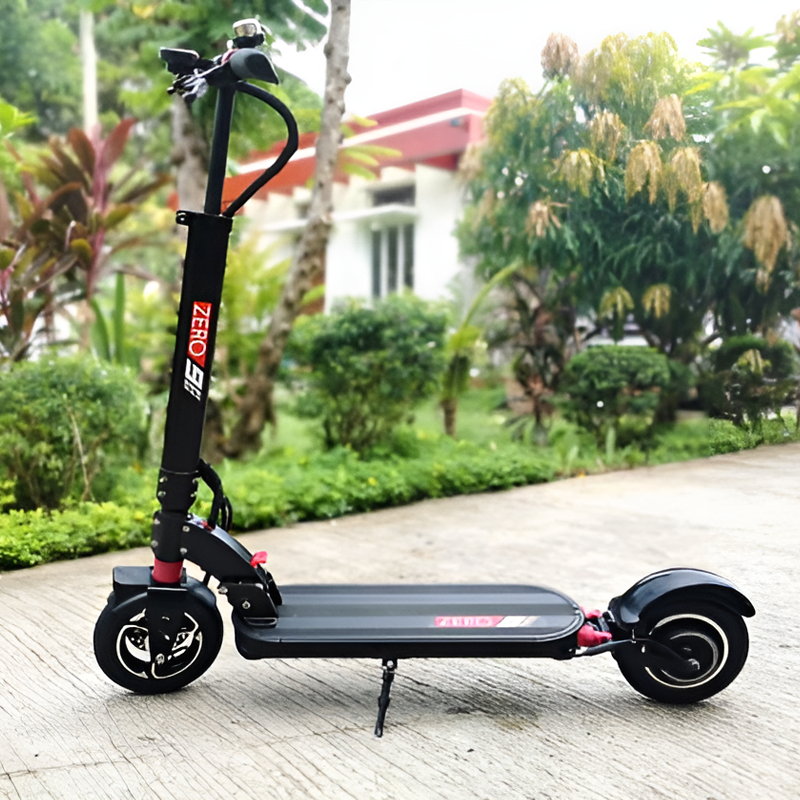
Zero 9 vs NIU KQi Air: Key Differences
| Specification | Zero 9 | NIU KQi Air |
|---|---|---|
| Motor | 600W nominal / 1,200W peak | 350W nominal / 700W peak |
| Battery | 48V 13Ah | 48V 9.4Ah |
| Battery capacity | 624Wh calculated | 451.2Wh calculated |
| Top speed | 30 mph claimed / 28.4 mph tested | 20 mph claimed / 20.1 mph tested |
| Claimed range | Up to 25 mi | Up to 31 mi |
| Tested range | 21.7 mi | 24.2 mi at ~15 mph |
| Weight | ~40 lb listed / 41.4 lb tested | 26.2 lb |
| Folded dimensions | ~43 × 7 × 14 in | ~44.9 × 7.5 × 18.9 in |
| Tires | 8.5-in pneumatic | 9.5-in tubeless pneumatic |
| Suspension | Front + rear dual spring | None |
| Brakes | Front disc + rear drum | Front disc + electronic regenerative braking |
| Water resistance | IP54 | IP55 |
| Charging time | ~6 hours | ~5 hours |
| Maximum rider weight | 220 lb | 265 lb |
| Current sale price | ~$799 | ~$849 |
Battery capacity is calculated from voltage × amp-hours. Claimed range and independently tested range are different measurements and should not be treated as interchangeable.
Speed: Zero 9 Has the Clear Advantage
If speed is your deciding factor, the Zero 9 wins by a substantial margin.
DRIDER rates it as the Zero 9 30 mph, with the manufacturer stating that GPS verification reaches approximately 29 mph. More importantly for a comparison, independent RiderGuide testing recorded 28.4 mph.
The NIU KQi Air is designed around a much more conservative urban-commuter speed. NIU lists its maximum speed at 20 mph, while ERideHero recorded approximately 20.1 mph in testing.
That produces a meaningful difference:
- Zero 9 tested: 28.4 mph
- KQi Air tested: 20.1 mph
- Difference: 8.3 mph
- Zero 9 advantage: approximately 41% higher tested top speed
The claimed figures produce an even larger 50% difference, but the independently tested numbers provide the more useful comparison.
- That extra speed is not merely a specification-sheet advantage. A rider who regularly travels on open roads or wants to cruise above 20 mph will immediately notice the Zero 9's additional performance. Its 600W nominal motor also gives it a larger performance margin than the KQi Air's 350W motor.
The KQi Air, however, is not slow for a 26.2-lb commuter scooter. A tested speed of 20.1 mph is enough for ordinary urban trips where speed limits, traffic and pedestrian areas naturally restrict how fast a rider should travel.
Weight & Portability: The KQi Air's Carbon-Fiber Advantage
This is where the NIU KQi Air changes the equation completely.
The Zero 9 weighs around 40 lb according to its listed specification, while RiderGuide measured 41.4 lb. The KQi Air weighs just 26.2 lb. Using the independently measured Zero 9 weight:
41.4 − 26.2 = 15.2 lb
The KQi Air is therefore approximately:
15.2 ÷ 41.4 × 100 = 36.7% lighter
That is a difference you can feel every time you carry the scooter.
The KQi Air's carbon-fiber construction is central to this design. Instead of adding suspension and heavier hardware for a more performance-oriented ride, NIU focuses on reducing mass while maintaining useful commuter performance.
That makes the KQi Air particularly attractive for people who:
- Carry their scooter up stairs every day
- Combine scooters with trains or buses
- Store the scooter underneath a desk
- Live in an apartment without elevator access
- Need to lift the scooter into a vehicle
- Frequently move the scooter when not riding
The folded dimensions are not dramatically smaller than the Zero 9. In fact, the KQi Air is listed at approximately 44.9 × 7.5 × 18.9 inches folded, compared with roughly 43 × 7 × 14 inches for the Zero 9 in the cited independent measurements.
- So its major portability advantage is weight, rather than simply having the smallest folded footprint.
A 26.2-lb scooter can be carried with one hand far more easily than a 41.4-lb machine. For a mixed-mode commuter, that can matter more than an additional 8 mph of top speed.
Range & Battery Capacity
Battery size reveals another major difference between these scooters. The Zero 9 uses a 48V 13Ah battery. Multiplying voltage by amp-hours gives:
48V × 13Ah = 624Wh
The NIU KQi Air uses a 48V 9.4Ah battery:
48V × 9.4Ah = 451.2Wh
That means the Zero 9 carries approximately 38% more battery energy. DRIDER claims up to 25 miles for the Zero 9. RiderGuide recorded 21.7 miles in its testing.
NIU claims up to 31 miles for the KQi Air, but that figure comes from controlled manufacturer testing rather than a typical high-speed ride. ERideHero's independent testing produced different results depending on riding mode:
- 18.5 miles in speed-priority testing at roughly 17.8 mph average
- 24.2 miles in normal commuting at roughly 15 mph average
- 27.3 miles in range-priority mode at approximately 12.6 mph
The 24.2-mile test is particularly useful for a moderate urban comparison, although the testing conditions were not identical to those used for the Zero 9.
That distinction is important. The KQi Air's 24.2-mile tested range was actually higher than the Zero 9's 21.7-mile tested range in the supplied independent results.
Real-world range can change considerably with:
- Rider weight
- Average speed
- Hills
- Temperature
- Riding mode
- Tire pressure
- Stop-and-go traffic
- Wind conditions
Ride Quality, Tires & Suspension
The Zero 9 and KQi Air also differ significantly in their approach to ride comfort. The Zero 9 uses 8.5-inch pneumatic tires along with front and rear dual spring suspension. This gives the scooter dedicated hardware for absorbing road imperfections.
- RiderGuide's testing found the Zero 9's suspension and pneumatic tires well suited to paved roads and light off-road surfaces. That combination is particularly useful when the route includes broken pavement, bumps or uneven surfaces.
The KQi Air takes the opposite approach. It uses larger 9.5-inch tubeless pneumatic tires but has no conventional suspension.
- The larger tires and carbon-fiber frame can help the Air deliver a smoother ride than its rigid construction might suggest. However, there is a fundamental hardware difference: the Zero 9 has two spring-suspension systems, while the KQi Air relies on its tires and frame characteristics to absorb road vibration.
For smooth city streets, the KQi Air's rigid design is not necessarily a problem. It also helps keep the scooter lightweight. For rougher roads and longer rides, however, the Zero 9 has the more substantial comfort hardware.
Braking & Safety
The braking systems are also different. The Zero 9 uses a front disc brake and rear drum brake. RiderGuide recorded a stopping distance of approximately 10.2 feet from 15 mph to 0 mph, which is a strong result under its testing conditions.
- The KQi Air combines a front disc brake with electronic regenerative braking, without a conventional mechanical rear brake. ERideHero recorded approximately 12.4 feet from 15 mph to 0 mph in its testing.
- That creates a measured difference of about 2.2 feet between the cited tests.
However, braking-distance results should not be treated as laboratory-equivalent figures because rider weight, surface, tire condition, temperature and test procedure can affect the result.
- The Zero 9 also has the advantage of front and rear mechanical braking hardware, while the KQi Air prioritizes a lighter system.
Both scooters have water-resistance ratings intended for splash exposure rather than unrestricted wet-weather riding. The Zero 9 is rated IP54, while the KQi Air is rated IP55.
Which One Should You Buy?
Choose the Zero 9 if you want:
- A substantially higher top speed
- Stronger motor performance
- A larger 624Wh battery
- Front and rear suspension
- A more substantial braking setup
- Better performance on uneven roads
- A performance-oriented commuter
- More performance for roughly the same current sale price
The Zero 9 makes more sense when the scooter will spend most of its life being ridden rather than carried.
Choose the NIU KQi Air if you want:
- A scooter weighing only 26.2 lb
- Carbon-fiber construction
- Easier stair carrying
- Easier public-transport integration
- Easier office or apartment storage
- Larger 9.5-inch pneumatic tires
- Good urban range without carrying a heavy battery platform
The KQi Air makes more sense when portability is part of the daily commute, not an occasional convenience. If you ride five miles to a train station, carry the scooter onto the train, take it upstairs at work and then ride again, the 15.2-lb weight difference becomes much more important.
Zero 9 vs NIU KQi Air: Comparison
| Category | Winner | Why |
|---|---|---|
| Top speed | Zero 9 | 28.4 mph tested vs 20.1 mph |
| Motor performance | Zero 9 | 600W nominal vs 350W |
| Battery capacity | Zero 9 | 624Wh vs 451.2Wh calculated |
| Tested range | KQi Air | 24.2 mi vs 21.7 mi in cited tests |
| Weight | KQi Air | 26.2 lb vs 41.4 lb |
| Portability | KQi Air | About 36.7% lighter |
| Ride comfort | Zero 9 | Pneumatic tires plus front/rear suspension |
| Braking | Zero 9 | Stronger cited stopping result and mechanical front/rear setup |
| Current sale price | Zero 9 | ~$799 vs ~$849 |
| Performance value | Zero 9 | More speed, motor power and battery capacity |
| Multimodal commuting | KQi Air | Much easier to carry |
| Best for performance | Zero 9 | Significantly higher speed and stronger hardware |
For most riders choosing primarily on speed, ride hardware and performance per dollar, the Zero 9 is the stronger buy. Its independently tested 28.4 mph top speed is dramatically higher, while its suspension and larger battery make it better suited to riders who prioritize performance.
The NIU KQi Air is the better choice when carrying weight is a daily concern. At just 26.2 lb, it is roughly 37% lighter than the tested Zero 9, and that difference can transform a scooter from something you avoid carrying into something practical to take onto public transportation or up a flight of stairs.
So the decision is straightforward:
Buy the Zero 9 for performance. Buy the KQi Air for portability.
Ready to ride?
If the Zero 9's extra speed, suspension and larger battery fit your commute, you can explore the Zero 9 from DRIDER before making your decision.

