



Zero 9 vs Segway Ninebot Max G2: Compact Speed vs Modern Range
The 30 Mph Zero 9 scooter is approximately 26% lighter and 65% narrower when folded, but the Segway Max G2 offers longer tested range, larger self-sealing tires, and stronger current U.S. support.
That contrast defines the Zero 9 vs Segway Ninebot Max G2 comparison. The Zero 9 is an older, performance-oriented scooter with higher maximum-speed potential and a remarkably compact folded shape. The Max G2 is a heavier, more modern commuter built around range, comfort, technology, and everyday convenience.
Price complicates the original lighter, narrower, cheaper angle. The Zero 9 is about 26% lighter, 65% narrower when folded, and faster by manufacturer specifications. The Segway Max G2 offers longer tested range, larger self-sealing tires, a higher payload, IPX5 documentation, modern app features, and a lower verified U.S. price.
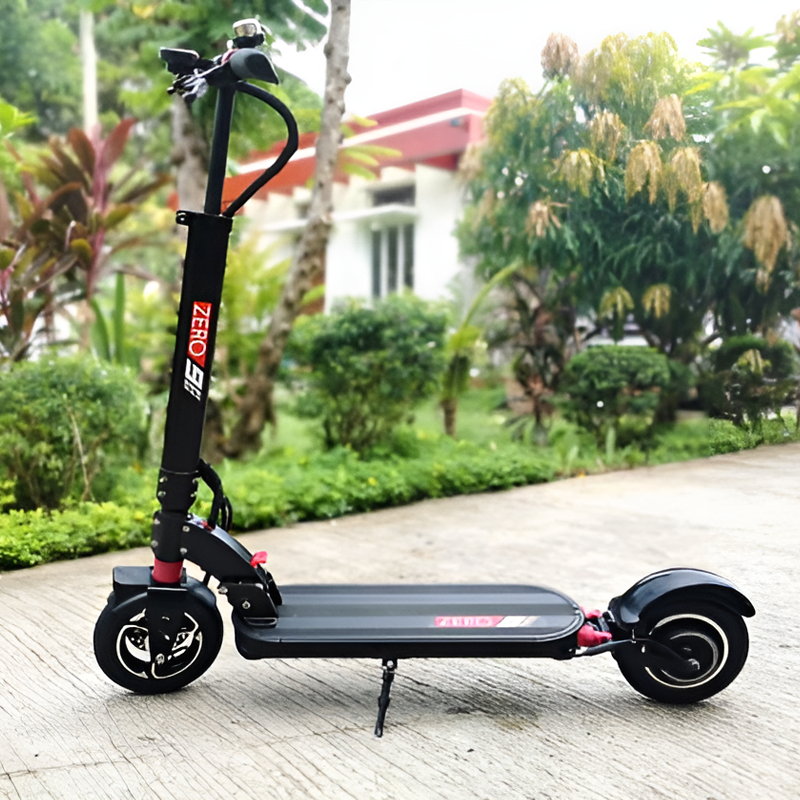
Zero 9 vs Segway Ninebot Max G2 Quick Verdict
Choose the Zero 9 if you regularly carry your scooter, have limited storage space, or prioritize higher maximum-speed potential. Its folding handlebars, telescopic stem, and 39.7-pound weight make it much easier to manage in apartments and vehicle trunks.
Choose the Segway Ninebot Max G2 if you prioritize tested range, modern commuter features, larger tubeless tires, and current retail support. It also offers front-and-rear suspension, IPX5 water-resistance documentation, Apple Find My integration, turn signals, and a higher payload.
The Zero 9 is the stronger portability choice, while the Max G2 is the more complete modern commuter.
| Specification | Zero 9 | Segway Ninebot Max G2 |
|---|---|---|
| Manufacturer top speed | 29.2 mph international specification | 20 mph default; 22 mph through the app |
| Published speed | 24 mph | 21.7–22.4 mph |
| 0–15 mph | 4.2 seconds | 4.1–4.65 seconds |
| Manufacturer range | Approximately 28 miles | 43 miles at 10 mph |
| Higher-speed range | Not officially specified | 28 miles at 20 mph; 25 miles at 22 mph |
| Realistic or tested range | Approximately 18 miles at full power | 21.3–33.4 miles depending on test pace |
| Battery | 624 Wh | 551 Wh |
| Nominal motor | 600 W | 450 W |
| Weight | Approximately 39.7 pounds | Approximately 53.5 pounds |
| Folded dimensions | 39.4 × 7.9 × 15.4 inches | 47.6 × 22.4 × 23.8 inches |
| Tires | 9-inch pneumatic | 10-inch tubeless self-sealing |
| Suspension | Front and rear spring shocks | Front hydraulic and rear spring |
| Water resistance | No verified IP rating | IPX5 |
| Maximum payload | Approximately 220 pounds | Approximately 265 pounds |
| Researched price | $999 plus shipping estimate | $699.99 |
Speed and Acceleration
The Zero 9 top speed depends on the regional configuration. The official ZERO product page lists an international top speed of 47 km/h, or approximately 29.2 mph. However, it also identifies a Singapore-compliant version capped at 25 km/h.
The U.S.-spec Max G2 is slower. Segway's official specifications list 20 mph as the factory-default maximum. Riders can enable approximately 22 mph through the Segway-Ninebot app.
Using the manufacturers' highest applicable figures:
The international Zero 9 specification is approximately 33% higher than the Max G2's app-enabled speed. That makes the Zero 9 a near-30 mph electric scooter by its uncapped international specification, but it does not mean every version will reach 29.2 mph.
Electric Scooter Insider reports 24 mph for the Zero 9. Rider Guide recorded 21.7 mph for the Max G2, while ERideHero measured 22.4 mph.
- Comparing 24 mph with 21.7 mph gives the Zero an approximately 10.6% advantage. Comparing it with 22.4 mph reduces the difference to 7.1%.
- Acceleration is essentially even based on the available reports. The Zero 9 reached 15 mph in 4.2 seconds. Rider Guide recorded 4.1 seconds for the Max G2, while ERideHero averaged 4.65 seconds with a best run of 4.24 seconds.
Rider weight, battery charge, controller settings, temperature, tires, surface conditions, and testing equipment can all influence acceleration.
- The Zero's 600 W nominal motor is 33.3% higher than the Max G2's 450 W nominal rating. However, nominal wattage alone does not determine acceleration, hill performance, efficiency, or overall ride quality. Segway also publishes a 1,000 W maximum output, which should not be compared directly with the Zero's nominal rating.
Folding and Portability
Portability is the Zero 9's most convincing advantage. It weighs approximately 39.7 pounds, compared with 53.5 pounds for the Max G2.
That makes the Zero 9 approximately 26% lighter. The difference is 13.8 pounds, which becomes significant when carrying a scooter upstairs or lifting it into a vehicle.
- Folded size creates an even wider gap. The Zero 9 folds to approximately 39.4 × 7.9 × 15.4 inches. The Max G2 measures approximately 47.6 × 22.4 × 23.8 inches when folded.
The Zero 9 is approximately 65% narrower when folded.
It is also approximately 17% shorter and 35% lower. Its folding handlebars and telescopic stem allow it to fit into spaces where the Max G2 may feel cumbersome.
Neither scooter is truly effortless to carry. Still, the Zero 9 is clearly more suitable for walk-up apartments, crowded storage rooms, vehicle trunks, and storage beside or underneath a desk.
Range and Battery Capacity
The Max G2 has the range advantage, but its figures need careful explanation. Segway lists a theoretical maximum of 43 miles, but that figure applies to operation at approximately 10 mph.
Segway also provides speed-specific figures:
- Approximately 28 miles at 20 mph
- Approximately 25 miles at 22 mph
The 43-mile claim is 53.6% higher than the Zero 9's official 28-mile figure. However, comparing those numbers without mentioning speed conditions would create a misleading impression.
The difference between the Max G2's own Eco and high-speed figures is revealing:
Its 25-mile range at 22 mph is approximately 42% below its 43-mile Eco-mode figure. Riders who intend to travel near maximum speed should plan around the lower number rather than treating 43 miles as a guaranteed commuting distance.
Independent tests reinforce the effect of riding pace. The Rider Guide measured 26.6 miles. ERideHero recorded:
- 21.3 miles in speed-priority testing
- 29.8 miles at a regular pace
- 33.4 miles in range-priority testing
Electric Scooter Insider estimates approximately 18 miles for the Zero 9 in full-power use. Compared with that estimate, Rider Guide's Max G2 result is approximately 47.8% higher.
- Interestingly, the Zero 9 has the larger nominal battery. Its 48 V, 13 Ah battery equals approximately 624 Wh, compared with 551 Wh for the Max G2.
The Zero therefore has approximately 13% more nominal battery energy. Its shorter published range does not necessarily indicate a poor battery. Its higher speed potential and more powerful nominal motor can consume energy faster, particularly during aggressive acceleration and high-speed riding.
Ride Quality, Suspension, and Tires
Both scooters have front-and-rear suspension, correcting a common comparison error. The Zero 9 uses front and rear spring shocks, while the Max G2 combines front hydraulic suspension with a rear spring system.
- The Zero pairs its suspension with 9-inch pneumatic tires. The Max G2 uses 10-inch tubeless, self-sealing pneumatic tires.
The Max G2's tire diameter is approximately 11.1% larger:
Larger tires generally handle small cracks and road imperfections more smoothly. The Max G2's tubeless construction also removes inner tubes, while its self-sealing layer may reduce inconvenience from some small punctures. It does not make the tires puncture-proof.
- The Zero 9 still provides a strong comfort setup for a scooter weighing under 40 pounds. Its lower weight and narrow frame can make it easier to maneuver in confined environments.
Braking and Safety
The Zero 9 uses a front mechanical disc brake and rear drum brake. Electric Scooter Insider measured a stopping distance of approximately 10.8 feet from 15 mph.
- The Max G2 uses an enclosed front drum brake with rear electronic regenerative braking. ERideHero recorded an average stopping distance of approximately 11.7 feet from 15 mph across ten runs.
- The Zero result is around 0.9 feet shorter, or 7.7% relative to the Max G2 figure. That small difference does not prove the Zero 9 is safer because the tests used different scooters, riders, surfaces, and protocols.
A disc brake can provide direct mechanical bite but leaves more hardware exposed for adjustment and maintenance. The Max G2's enclosed drum favors simpler upkeep, while its regenerative braking strength can be adjusted through the app.
Regardless of model, riders should inspect the folding mechanism, brakes, tires, fasteners, and lights regularly. A properly fitted helmet and protective equipment are particularly important on a scooter capable of speeds approaching 30 mph.
- Electric-scooter rules differ across U.S. states and cities. Buyers should check local speed limits, helmet requirements, sidewalk restrictions, and road or bike-lane regulations before riding.
Who Should Buy the Zero 9?
The Zero 9 is the better choice for someone who needs a relatively lightweight electric scooter that can fit into tight storage spaces.
Consider it if you:
- Carry your scooter upstairs
- Regularly place it in a vehicle trunk
- Need folding handlebars
- Have limited apartment or office storage
- Value higher maximum-speed potential
- Prefer a lighter performance-oriented design
- Can verify the exact configuration and seller support
Its combination of dual suspension, a 600 W nominal motor, and approximately 39.7-pound weight remains distinctive.
Who Should Buy the Segway Ninebot Max G2?
The Max G2 is the stronger choice for riders looking for a modern, long-range electric scooter that will usually be ridden and parked rather than carried.
Consider it if you:
- Prioritize independently tested range
- Want larger self-sealing tubeless tires
- Value front-and-rear suspension
- Need a 265-pound payload
- Want app controls and Apple Find My
- Prefer turn signals and traction control
- Want stronger current U.S. retail support
- Rarely carry the scooter upstairs
Its 53.5-pound weight is the main compromise. Commuters who combine scooter travel with stairs, buses, or trains should test whether they can handle that weight before buying.
The portability pick
If a ~39.7 lb weight and a 7.9-inch folded width fit your commute better than a 53.5 lb commuter, shop the Zero 9 at $799 →
Frequently Asked Questions
Is the Zero 9 faster than the Segway Ninebot Max G2?
Yes. The uncapped international Zero 9 specification is approximately 29.2 mph versus the Max G2's app-enabled 22 mph. Published performance figures narrow the Zero's advantage to approximately 7%–11%.
What is the Segway Ninebot Max G2 top speed?
The default maximum is approximately 20 mph. Riders can enable approximately 22 mph through the Segway-Ninebot app.
How much does the Segway Ninebot Max G2 weigh?
The official Segway Ninebot Max G2 weight is approximately 53.5 pounds. The Zero 9 weighs approximately 39.7 pounds.
Which scooter has more real-world range?
The Max G2. Independent results range from 21.3 to 33.4 miles depending on riding pace, while the selected Zero 9 review estimates approximately 18 miles in full-power use.
Which scooter is easier to carry and store?
The Zero 9. It is approximately 13.8 pounds lighter and 65% narrower when folded.
Does the Segway Max G2 have suspension?
Yes. It has front hydraulic and rear spring suspension. The Zero 9 also has front-and-rear spring suspension.
Is the Segway Max G2 waterproof?
No. It has an IPX5 water-resistance rating, but that does not make it waterproof.
Was the Segway Ninebot Max G2 recalled?
The widely reported 2025 recall covered the Max G30P and G30LP, not the Max G2. Check current CPSC and Segway notices using the exact model number.
Is the Segway Ninebot Max G2 worth it in 2026?
It can be worth buying for its tested range, suspension, self-sealing tires, higher payload, modern features, and current retail support. Its heavy 53.5-pound weight remains its biggest disadvantage.
Is the Zero 9 a true 30 mph electric scooter?
It is a near-30-mph scooter by the uncapped international 29.2-mph specification. A U.S.-oriented review reports 24 mph, so configuration and conditions matter.
Which scooter is better for daily commuting?
Choose the Zero 9 for carrying, stairs, trunks, and tight storage. Choose the Max G2 for longer trips, modern features, larger tubeless tires, and lower-maintenance commuting.

