



Zero 9 vs NIU KQi3 Pro: Compact Speed vs Long-Range Commuter
If you are choosing between the Zero 9 vs NIU KQi3 Pro, the biggest difference is not subtle: the Zero 9 is considerably faster and folds into a much narrower package, while the NIU KQi3 Pro is built around a slower, more conventional commuter setup with a higher claimed range.
The Zero 9 reaches about 29 mph in GPS-verified testing, compared with the KQi3 Pro's 19.9-mph rated top speed. That's roughly a 46% higher top speed for the Zero 9. It is also about 40 lb, versus roughly 44.8 lb for the NIU, and its folded width is approximately 7.9 inches, compared with about 21 inches for the KQi3 Pro.
The tradeoff is range. The Zero 9 is rated for about 25 miles, while NIU claims 31 miles for the KQi3 Pro, about 24% more claimed range.
So the decision is straightforward: choose the Zero 9 for speed, compact storage, portability, and suspension; choose the NIU KQi3 Pro for higher claimed range, dual mechanical disc brakes, and a more traditional commuter-oriented design.
Want to take a closer look? Explore the Zero 9 30 mph electric scooter for full details.
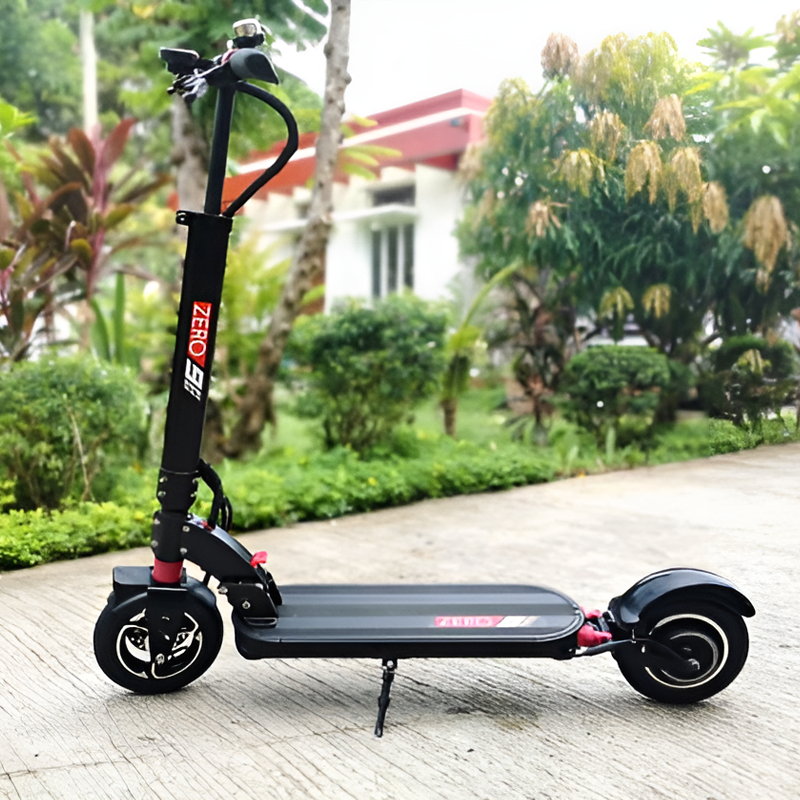
Zero 9 vs NIU KQi3 Pro: Specs at a Glance
| Specification | Zero 9 | NIU KQi3 Pro |
|---|---|---|
| Top speed | ~29 mph tested / marketed around 30 mph | 19.9 mph |
| Motor | 48V / 600W | 350W nominal / 700W peak |
| Claimed range | ~25 miles / ~45 km | 31 miles / 50 km |
| Battery | 48V 13Ah (~624 Wh) | ~486 Wh |
| Weight | ~40 lb | ~44.8 lb |
| Folded dimensions | ~39.4 × 7.9 × 15.4 in | ~46 × 21 × 21 in |
| Folded width | ~7.9 in | ~21 in |
| Tires | Pneumatic, ~8.5–9 in depending on specification | Tubeless pneumatic, ~9.5 in |
| Suspension | Front and rear | None |
| Brakes | Front disc + rear drum | Dual mechanical disc + regenerative braking |
| Charging time | ~6 hours | ~6 hours |
Speed: Zero 9 Wins Easily
The Zero 9 top speed is the clearest reason to choose it over the KQi3 Pro. The Zero 9 uses a 48V/600W motor and has been GPS-verified at approximately 29 mph in independent testing. Its advertised positioning is around the 30-mph class.
- The KQi3 Pro is fundamentally different. NIU rates its scooter at 19.9 mph, with a 350W nominal motor and 700W peak output.
That creates a substantial gap:
(29 − 19.9) ÷ 19.9 × 100 = approximately 45.7%
In other words, the tested Zero 9 top speed is roughly 46% higher than the KQi3 Pro's rated maximum.
- That does not mean the Zero 9 will always travel 46% faster during a commute. Acceleration, traffic, terrain, battery level, rider weight, wind, tire pressure, and speed restrictions all affect actual riding speed.
It also does not mean the Zero 9's 600W motor is automatically 71% better than the NIU's 350W motor. Motor power ratings can be reported differently, and peak power is not the same thing as continuous output.
- For riders who specifically want a 30 mph electric scooter, however, the Zero 9 is in a completely different performance category from the 19.9-mph KQi3 Pro.
2. Foldability & Portability: The Zero 9 Has the Bigger Advantage
Portability is arguably the Zero 9's strongest advantage after speed. The Zero 9 weighs approximately 40 lb and folds to roughly 1000 × 200 × 390 mm, or about 39.4 × 7.9 × 15.4 inches. The KQi3 Pro weighs about 44.8 lb and has folded dimensions of approximately 46 × 21 × 21 inches.
The weight difference is:
44.8 − 40 = 4.8 lb
Relative to the KQi3 Pro, the Zero 9 is approximately:
4.8 ÷ 44.8 × 100 = 10.7% lighter
So calling it roughly 11% lighter is reasonable. Four or five pounds may not sound enormous on paper, but it becomes noticeable when you repeatedly lift a scooter into a vehicle, carry it up stairs, or move it through an office.
The folded-width difference is much more dramatic.
21 − 7.9 = 13.1 inches
The Zero 9 is therefore approximately 62% narrower than the KQi3 Pro based on these widths. Another way to express the difference: the KQi3 Pro's quoted folded width is about 2.7 times the Zero 9's folded width, not quite three times.
- A roughly 7.9-inch-wide folded Zero 9 can be easier to slide beside a desk, behind furniture, into a narrow storage area, or alongside other luggage. A scooter around 21 inches wide requires substantially more storage space.
For commuters who combine riding with a car, train, bus, or office commute, folded dimensions can matter almost as much as riding specifications. If you routinely carry your scooter, the Zero 9 is the clear winner.
3. Range & Battery: KQi3 Pro Wins on Claimed Range
The NIU KQi3 Pro range is its strongest specification advantage. The Zero 9 uses a 48V 13Ah battery, equivalent to approximately:
48 × 13 = 624 Wh
Its claimed range is approximately 25 miles or about 45 km. The KQi3 Pro uses a battery of approximately 486 Wh and carries a manufacturer-rated range of 31 miles.
That gives the NIU a claimed range advantage of:
31 − 25 = 6 miles
And:
6 ÷ 25 × 100 = 24%
So the KQi3 Pro offers approximately 24% more claimed range than the Zero 9. However, this is where the numbers need careful interpretation.
A larger battery does not automatically mean a scooter will travel farther in every real-world situation. Efficiency, motor calibration, rider weight, speed, hills, wind, tire pressure, temperature, and stop-and-go traffic all affect consumption.
More importantly, independent testing does not necessarily reproduce the manufacturers' maximum-range figures. In the research used for this comparison, the Zero 9 covered about 21.7 miles in one real-world test. A KQi3 Pro test recorded roughly 33.6 km, or about 21 miles.
If your commute is long enough that the extra claimed six miles matters, the NIU deserves the advantage. If your daily route is comfortably within the Zero 9's practical range, its speed and portability may matter more.
4. Ride Quality: Suspension vs. Tire Cushioning
The Zero 9 and KQi3 Pro take different approaches to ride comfort. The Zero 9 combines pneumatic tires with front and rear suspension. Its configuration includes front spring suspension and rear air-shock support.
- That gives the scooter a mechanical way to absorb bumps before those impacts reach the rider.
- For riders dealing with cracked pavement, uneven roads, expansion joints, or rougher city surfaces, dedicated suspension can be a meaningful advantage.
- The KQi3 Pro does not use dedicated suspension. Instead, it relies on its tubeless pneumatic tires to provide some cushioning.
Its larger approximately 9.5-inch tires can still provide useful compliance over ordinary road imperfections, but pneumatic tires and suspension are not the same thing.
This makes the choice fairly simple:
- Rougher roads: Zero 9 has the more forgiving hardware.
- Smooth pavement: KQi3 Pro's lack of suspension may be less important.
- Comfort-focused riders: Zero 9 has the stronger specification.
- Simple commuter setup: KQi3 Pro keeps things straightforward.
The Zero 9 therefore wins the suspension category, but better ride remains dependent on the road surface and rider preferences.
5. Braking: Different Hardware, Different Priorities
The braking systems are another meaningful difference in the Zero 9 vs KQi3 Pro comparison.
- The Zero 9 uses a front disc brake and rear drum brake.
- The KQi3 Pro uses dual mechanical disc brakes, front and rear, supplemented by regenerative braking.
From a hardware perspective, the NIU has two mechanical disc brakes, while the Zero 9 combines a disc and drum.
- That makes the KQi3 Pro particularly attractive to riders who prioritize a conventional dual-disc braking arrangement.
Stopping distance depends on much more than brake type. Tire condition, tire pressure, rider weight, road surface, temperature, brake adjustment, and rider reaction all matter.
For either scooter, correct adjustment and appropriate riding speed matter more than a specification-sheet comparison alone.
6. Build, Tires & Everyday Usability
The Zero 9 is designed around performance and portability. Its pneumatic tires provide air cushioning, while its suspension adds another layer of impact absorption. The folding mechanism also contributes directly to its usefulness for riders who need to transport the scooter.
- Its approximately 40-lb weight is not ultra-light, but it is advantageous relative to the heavier KQi3 Pro.
- The KQi3 Pro takes a more conventional commuter approach. Its tubeless pneumatic tires eliminate inner tubes, while its dual mechanical disc brakes provide braking hardware on both wheels.
Tubeless tires can also be appealing to commuters because there is no inner tube to pinch or replace. That does not make them puncture-proof, though; tire condition and road debris still matter.
The KQi3 Pro's wider folded package is the biggest everyday compromise. It may be perfectly manageable for home storage, but riders with limited apartment, car, or office space should pay attention to the actual folded dimensions before buying.
- For daily usability, neither scooter wins every category. The Zero 9 is more compact and performance-oriented; the KQi3 Pro is more conservative and range-focused.
Which One Should You Buy?
Buy the Zero 9 if speed is your priority
The Zero 9 is the obvious choice if 19.9 mph isn't enough.
Its approximately 29-mph tested top speed puts it around 46% above the KQi3 Pro's rated maximum. That is a major difference for riders who prioritize faster travel.
It is also the better option if you regularly need to carry your scooter. At approximately 40 lb, it is about 11% lighter than the KQi3 Pro, while its approximately 7.9-inch folded width is dramatically smaller.
Choose it if you value:
- Higher top speed
- Narrow folded dimensions
- Lower weight
- Front and rear suspension
- A performance-oriented commuter
- A 25-mile claimed range that is sufficient for your route
Buy the KQi3 Pro if range and conventional commuting matter more
The KQi3 Pro is the more sensible choice for riders who don't need 30-mph-class performance.
Its 19.9-mph top speed is adequate for many urban commuting situations, while its claimed 31-mile range gives it a six-mile advantage over the Zero 9's claimed 25 miles.
It also has dual mechanical disc brakes and tubeless pneumatic tires.
Choose it if you value:
- Higher claimed range
- Dual mechanical disc brakes
- Tubeless pneumatic tires
- A conventional commuter setup
- 19.9 mph being sufficient
- Longer-distance daily riding
Ready to ride faster?
If speed, a 7.9-inch folded width, and front-and-rear suspension top your list, shop the Zero 9 at $799 →
Frequently Asked Questions
What is the NIU KQi3 Pro's top speed?
The NIU KQi3 Pro has a manufacturer-rated top speed of 19.9 mph. Actual speed can vary with rider weight, battery charge, terrain, temperature, wind, and other conditions.
How much does the NIU KQi3 Pro weigh?
The KQi3 Pro weighs approximately 44.8 lb including its battery according to the manufacturer's specification used in this comparison. Independent testing commonly rounds the figure to about 45 lb.
Is the Zero 9 faster than the NIU KQi3 Pro?
Yes. The Zero 9 has been GPS-verified at approximately 29 mph, compared with the KQi3 Pro's 19.9-mph rating. Using those figures, the Zero 9's tested top speed is approximately 46% higher.
Does the Zero 9 have better range than the NIU KQi3 Pro?
No. Based on claimed specifications, the KQi3 Pro has the advantage: 31 miles versus approximately 25 miles for the Zero 9. That is roughly 24% more claimed range for the NIU. Independent testing can produce substantially lower figures for both scooters.
Is the NIU KQi3 Pro worth it?
Yes, if your priorities are range, dual mechanical disc brakes, tubeless pneumatic tires, and everyday commuting rather than high speed. Its 19.9-mph maximum is significantly lower than the Zero 9's tested speed, so speed-focused riders may prefer the Zero 9.
Which is better for commuting, Zero 9 or NIU KQi3 Pro?
It depends on the commute. The Zero 9 is better for riders who need speed, portability, and suspension. The KQi3 Pro is better for riders who value its higher claimed range and dual-disc braking setup and do not need more than 19.9 mph.
Which scooter is lighter, Zero 9 or KQi3 Pro?
The Zero 9 is lighter at approximately 40 lb, compared with about 44.8 lb for the KQi3 Pro. That makes the Zero 9 approximately 11% lighter based on those figures.
Which scooter folds smaller?
The Zero 9 folds substantially narrower. Its folded width is approximately 7.9 inches, compared with roughly 21 inches for the KQi3 Pro. That makes the Zero 9 approximately 62% narrower by folded width, making it easier to store in tight spaces.

