



Zero 9 vs Segway Ninebot F2 Pro: Speed, Fold and Range Compared
What matters more: riding 42% faster or claiming 36% more range? That is the central question in the Zero 9 vs Segway Ninebot F2 Pro comparison. Independent testing puts the Zero 9 at approximately 28.4 mph, while the original U.S. F2 Pro tops out at around 20 mph. Fold them, and the difference becomes even bigger: the Zero 9's approximately 7.9-inch folded width is nearly 65% narrower than the F2 Pro's 22.4-inch profile.
- The F2 Pro fights back with a 34-mile theoretical range, 265 lb payload, 10-inch self-sealing tires, IPX5 water resistance, traction control, turn signals and Apple Find My.
Simple:
- Choose the Zero 9 for speed, compact storage, stronger tested braking, a larger battery and dual suspension.
- Choose the F2 Pro for smart features, higher payload, self-sealing tires and longer laboratory-tested range.
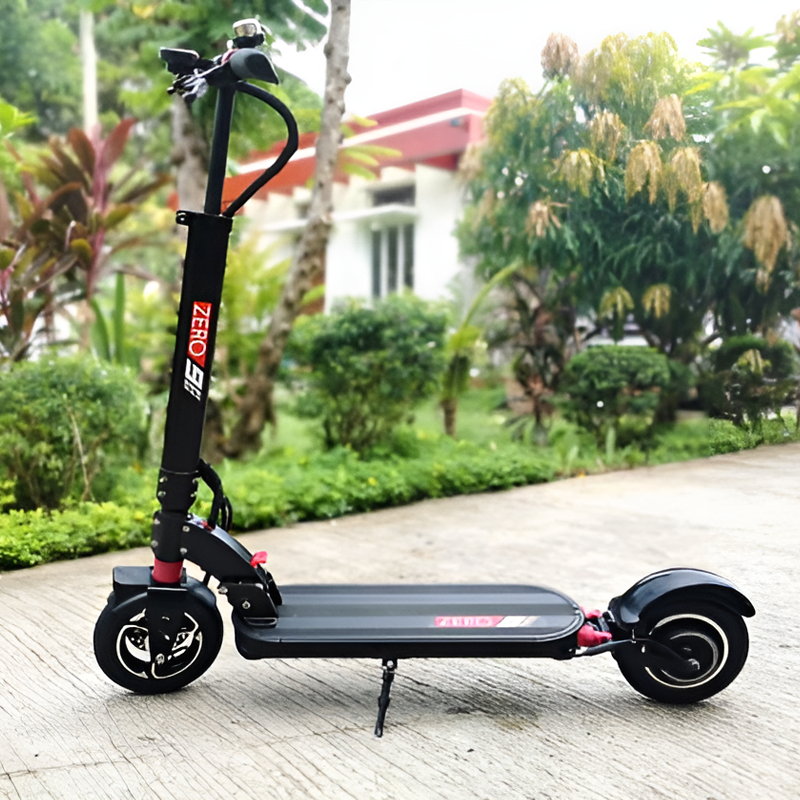
Zero 9 vs Segway Ninebot F2 Pro Specifications
| Specification | Zero 9 | Original U.S. F2 Pro |
|---|---|---|
| Advertised top speed | Up to 30 mph | 20 mph |
| Independently tested speed | 28.4 mph | 19.98 mph |
| Acceleration to 15 mph | 4.2 seconds | 5.4 seconds |
| Advertised range | Up to 25 miles | 34 theoretical miles |
| Tested range | 21.7 miles | 16.4–19.2 miles |
| Battery | 48V 13Ah, 624Wh | 36V 12.8Ah, 460Wh |
| Nominal motor power | 600W | 450W |
| Maximum motor output | Approximately 1,200W in review context | 900W |
| Weight | Approximately 40–41 lb | 40.8 lb |
| Maximum payload | 220 lb | 265 lb |
| Folded width | Approximately 7–7.9 inches | 22.4 inches |
| Tires | 8.5-inch pneumatic tube tires | 10-inch self-sealing tubeless tires |
| Suspension | Front and rear | Front only |
| Tested braking distance | 10.2 feet from 15 mph | 17.1 feet from 15 mph |
| Water-resistance rating | No verified IP rating | IPX5 |
| Charging time | Approximately 6 hours | Approximately 8 hours |
| Listed price | $799 | Formerly around $599.99–$799.99 |
| U.S. availability | Available through D-Rider | Original model discontinued |
Choose the 30 mph electric scooter from Zero 9 if you want substantially more speed, a compact fold, stronger tested braking and dual-suspension performance.
Zero 9 vs Segway Ninebot F2 Pro Speed
The biggest difference is speed. The Zero 9 reached approximately 28.4 mph during independent testing, while the original U.S. F2 Pro reached 19.98 mph.
That produces an 8.4 mph difference:
= ((28.4 − 20) ÷ 20) × 100
= (8.4 ÷ 20) × 100
= 42%
The Zero 9 is therefore approximately 42% faster.
Using D-Rider's approximately 29 mph GPS-verified result, the advantage rises to around 45%. The product is marketed as an up to 30 mph electric scooter, but real speed depends on several conditions:
- Rider weight
- Battery charge
- Terrain and incline
- Wind direction
- Temperature
- Tire pressure
- Controller settings
The F2 Pro's 20 mph limit is adequate for normal commuting. However, riders who want more performance headroom will notice the difference immediately.
Acceleration Difference
The Zero 9 reached 15 mph in approximately 4.2 seconds. The F2 Pro required around 5.4 seconds. That makes the Zero 9 approximately 1.2 seconds quicker, representing about a 22% reduction in acceleration time.
- At 28.4 mph, the Zero 9 travels approximately 41.7 feet every second. At 20 mph, the F2 Pro covers about 29.3 feet per second. The Zero 9 therefore travels approximately 12.4 additional feet during a one-second reaction period.
- That extra performance requires more attention, protective equipment and braking space.
Folding and Portability
Both scooters weigh approximately 41 lb, so neither has a meaningful weight advantage.
The real portability difference is folded width.
- The Zero 9 uses folding handlebars and a telescoping stem, giving it a folded width of approximately 7–7.9 inches, depending on the source and measurement. The F2 Pro's handlebars remain 22.4 inches wide after the stem is folded.
Using the 7.9-inch measurement:
= ((34 − 25) ÷ 25) × 100
= (9 ÷ 25) × 100
= 36%
Therefore, the F2 Pro claims approximately 36% more range than the Zero 9. The Zero 9 is approximately 65% narrower when folded.
- Put another way, the F2 Pro's folded width is approximately 2.8 times greater than the Zero 9's 7.9-inch profile.
This difference matters when storing a scooter:
- In a small apartment
- Beside an office desk
- Against a garage wall
- Between furniture
- Inside a crowded trunk
- Alongside other equipment
Neither scooter should be called lightweight. The Zero 9 is more compact to store, not necessarily easier to lift. Because current sources list slightly different Zero 9 dimensions, buyers should treat the 7–7.9-inch width as approximate.
Range and Battery
The original U.S. F2 Pro claims approximately 34 miles of theoretical range, while the Zero 9 is advertised for up to 25 miles.
That gives the F2 Pro a nine-mile advantage:
The F2 Pro therefore claims approximately 36% more range. However, Segway's 34-mile result was recorded under controlled conditions:
- Fully charged battery
- Approximately 165 lb rider
- Temperature of around 77°F
- Average speed of approximately 9.9 mph
- Paved riding surface
The 34-mile figure is a low-speed efficiency result, not a promise of 34 miles while traveling at 20 mph.
Real-World Range Tests
Independent testing recorded:
- Zero 9: approximately 21.7 miles
- F2 Pro with a 165 lb rider: approximately 19.2 miles
- F2 Pro with a 215 lb rider: approximately 16.4 miles
Compared with the 19.2-mile F2 Pro result, the Zero 9 traveled approximately 13% farther. Compared with the 16.4-mile result, it traveled approximately 32% farther.
Battery Capacity
The Zero 9 uses a 48V 13Ah battery:
= 48 V × 13 Ah
= 624 Wh
Therefore, the Zero 9 has a total battery capacity of approximately 624 Wh. The F2 Pro has a battery capacity of approximately 460Wh. The difference is 164Wh, meaning the Zero 9 stores approximately 36% more battery energy.
That does not guarantee 36% more range. The Zero 9's higher speed and stronger acceleration can consume its additional energy quickly.
Eventually, the conclusion is:
- The F2 Pro wins the official low-speed range claim.
- The Zero 9 wins battery capacity and still delivers credible 20-plus-mile tested range at a higher performance level.
Brakes, Tires and Suspension
The Zero 9 provides the stronger performance-oriented hardware. The F2 Pro emphasizes larger tires and electronic safety features.
1. Braking Statistics
The Zero 9 uses:
- Front disc brake
- Rear drum brake
- Regenerative braking
It recorded an approximately 10.2-foot stopping distance from 15 mph.
The F2 Pro combines a front disc brake with a rear electronic brake. Its cited stopping distance from 15 mph was approximately 17.1 feet.
The Zero 9 stopped approximately 6.9 feet sooner:
= (6.9 ÷ 17.1) × 100
= 40.4%
Its cited stopping distance was therefore approximately 40% shorter.
- These results do not prove that the Zero 9 is universally safer. Stopping performance changes with tire pressure, brake adjustment, surface grip, weather, rider weight and reaction time.
The Zero 9's higher top speed also increases the importance of braking technique and protective equipment.
2. Tire Comparison
The Zero 9 has 8.5-inch pneumatic inner-tube tires. They help absorb road vibration but require regular pressure checks. Inner tubes can also be vulnerable to punctures and pinch flats.
The F2 Pro uses 10-inch self-sealing tubeless tires. Its tires are approximately 17.6% larger in diameter:
= (1.5 ÷ 8.5) × 100
= 17.6%
Larger tires generally roll more easily over smaller road imperfections. The self-sealing layer can also reduce the inconvenience caused by minor punctures. The F2 Pro wins for lower tire-maintenance anxiety.
3. Suspension Comparison
The original F2 Pro has front spring suspension only. The Zero 9 provides front and rear spring suspension, allowing both ends of the scooter to absorb impacts. This makes it the stronger option for cracked pavement, broken roads and uneven urban surfaces.
- The F2 Pro's larger tires help compensate, but they cannot completely replace rear suspension.
Features and Everyday Ownership
The F2 Pro has a significant technology advantage.
Its commuter features include:
- Traction Control System
- Integrated turn signals
- Electronic horn
- Segway app
- Apple Find My
- Self-sealing tires
- IPX5 water resistance
- Higher payload capacity
The Zero 9 focuses on mechanical performance:
- Folding handlebars
- Telescoping stem
- Larger battery
- Dual suspension
- Faster acceleration
- Higher tested speed
- Mechanical front and rear brakes
IPX5 means the F2 Pro has documented protection against splashes and water jets. It does not mean the scooter is waterproof.
1. Payload Capacity
The F2 Pro supports a maximum rider load of 265 lb, compared with 220 lb for the Zero 9.
That is a 45 lb difference:
= (45 ÷ 220) × 100
= 20.5%
The F2 Pro supports approximately 20% more rated payload.
- Remember that payload includes the rider, clothing, backpack, lock and anything else carried on the scooter.
2. Charging Time
The Zero 9 requires approximately six hours to charge. The F2 Pro requires around eight hours.
The Zero 9's listed charging time is about 25% shorter:
= (2 ÷ 8) × 100
= 25%
This two-hour difference can matter for riders who need to recharge between commuting periods. Charging time may still vary with battery condition, temperature and charger specifications.
Which option is more suitable: Zero 9 Vs F2 Pro
The Zero 9 is the performance winner. It is approximately 42% faster, accelerates to 15 mph about 22% quicker, carries roughly 36% more battery energy and recorded an approximately 40% shorter stopping distance in the cited independent tests.
The F2 Pro is the smart-commuter winner. It supports about 20% more payload, claims 36% more maximum range, has larger self-sealing tires and provides technology the Zero 9 lacks.
Choose the Zero 9 if you want:
- 28–29 mph tested performance
- A folded profile approximately 65% narrower
- Front and rear suspension
- A 624Wh battery
- Faster acceleration
- Stronger tested braking
- Better performance on hills and rough roads
Choose the F2 Pro if you want:
- A controlled 20 mph commuter speed
- 34 miles of theoretical range
- A higher 265 lb payload
- 10-inch self-sealing tires
- IPX5 splash resistance
- Turn signals and traction control
The performance pick
Want the faster ride, the 65% narrower fold, and stronger tested braking? Shop the Zero 9 at $799 →
Frequently Asked Questions
What is the Segway Ninebot F2 Pro top speed?
The original U.S. Segway Ninebot F2 Pro has an official top speed of approximately 20 mph. Independent testing recorded 19.98 mph, closely matching the official claim. European models may be restricted to 15.5 mph or 12.4–12.5 mph.
How much does the Segway Ninebot F2 Pro weigh?
The original U.S. F2 Pro weighs approximately 40.8 lb. The Zero 9 weighs roughly 40–41 lb, so neither has a major weight advantage. The Zero 9's portability benefit comes from its much narrower folded profile.
Is the Zero 9 faster than the F2 Pro?
Yes. The Zero 9 reached approximately 28.4 mph during independent testing, compared with around 20 mph for the F2 Pro. The resulting 42% speed advantage makes the Zero 9 the clear performance winner.
Which scooter folds smaller?
The Zero 9 folds narrower because its handlebars collapse. Its folded width is approximately 7–7.9 inches, compared with 22.4 inches for the F2 Pro. Based on the 7.9-inch figure, the Zero 9 is approximately 65% narrower.
Does the F2 Pro really have a 40-mile range?
Not the original U.S. F2 Pro. Model 051203U is rated for approximately 34 theoretical miles. The 40.4-mile figure belongs to newer F2 Pro II variants and should not be assigned to the original model.
What is the real-world range of the F2 Pro?
Independent performance testing recorded approximately 19.2 miles with a 165 lb rider and 16.4 miles with a 215 lb rider. Actual range changes with speed, rider weight, hills, temperature, wind and tire pressure.
Which scooter is better for heavier riders?
The F2 Pro supports up to 265 lb, compared with 220 lb for the Zero 9. This gives it approximately 20% more payload capacity, making it the stronger option for heavier riders.
Which scooter has better suspension?
The Zero 9 has the more complete suspension system because it includes front and rear spring suspension. The original F2 Pro only has front suspension, although it counters with larger 10-inch tires.
Is the Segway Ninebot F2 Pro worth it in 2026?
The F2 Pro may still be worth buying at a meaningful discount from a reputable seller. Its smart features, tires and payload remain competitive. Because it is discontinued in the U.S., buyers should check battery condition, warranty coverage and parts availability.
Which scooter is better for commuting?
Choose the Zero 9 for speed, hills, rough pavement and compact storage. Choose the F2 Pro for self-sealing tires, connected features, higher payload and a controlled 20 mph pace. The best option depends on the route, rider and local regulations.

